
HSUHK's rise to 464th in Asia provided a timely backdrop in Bali, where university leaders looked beyond rankings to a larger question: how can greater international visibility create partnerships and opportunities that matter?
The Hang Seng University of Hong Kong (HSUHK) has risen 50 places to 464th in the QS World University Rankings: Asia 2027, marking another step forward in the University's growing regional profile. Beneath the overall result are two particular notable indicators: HSUHK ranks 107th in Asia for Citations per Paper and 107th for International Students.
The results were unveiled as higher education leaders, government and industry gathered in Bali, Indonesia, for the QS Higher Ed Summit: Asia Pacific 2026 from 3 to 5 November. More than 1,000 delegates were expected at the Summit, which brought together leaders from universities, government and industry to examine the next chapter of higher education across the region.
For HSUHK, however, Bali represented something larger than a movement in a ranking table.
The University arrived with greater regional recognition and a question about what should follow from it: how can growing visibility be turned into connections that create real academic value?
Across discussions with university leaders and institutions from around the region, one answer repeatedly came into view. International standing matters most when it creates possibilities for people: when students can learn across cultures, scholars can pursue questions across borders, and universities can address challenges that no institution can adequately tackle alone.
Competition may define rankings. Cooperation defines what comes next.
That idea came into focus when Professor Joshua Mok Ka-ho, President of HSUHK, joined the panel "The Partnership Imperative: Why International Collaboration Matters More Than Ever."
The subject speaks directly to one of higher education's defining contradictions. Universities are competing more intensely for talented students and academics, research resources, reputation and international recognition. At the same time, the forces reshaping universities, from artificial intelligence and shifting student mobility to geopolitical uncertainty and changing workforce demands, increasingly cross institutional and national boundaries.
The real question, then, is not whether universities compete or collaborate. They inevitably do both. The more consequential question is where competition should end and cooperation begin.
For HSUHK, this is more than an abstract debate. As the University expands its international connections, the measure of progress cannot simply be the number of partners or agreements it accumulates. What matters is what those relationships enable students and scholars to do.
A partnership becomes meaningful when a student can step into another academic environment; when researchers who might otherwise never meet begin working on a shared question; when classrooms become connected across borders; or when an institutional relationship develops into something that produces sustained educational and research opportunities.
Joining Professor Mok in the discussion were Professor Lin Tzu-Bin, Chief Executive Officer of the Foundation for International Cooperation in Higher Education of Taiwan; Yara Vasina of the Association of Commonwealth Universities; and Christopher Carey, Executive Director, Global Engagement at Massey University. Dr Elena Williams, Advisor to Australia Awards Indonesia and Research Fellow at Deakin University, moderated the session.
The discussion also reflected a wider theme of the Bali Summit. QS described the gathering as an opportunity to consider how internationalisation, workforce readiness and cross-border collaboration can be shaped by responsibility and shared prosperity, as the Asia-Pacific region takes on a larger role in global higher education.
Who will shape the AI century?
If international collaboration raised one question about the region's future, artificial intelligence raised another: will Asia Pacific help shape the AI century, or largely adapt to choices made elsewhere?
Professor Mok joined fellow university leaders at the invitation-only Presidents' Roundtable, "The AI Century: Will Asia Pacific Lead It?"
The conversation placed AI where it increasingly belongs in university leadership: not simply as a new classroom tool, but as a question about the future of education itself. What should students learn when technology can reproduce increasingly sophisticated forms of knowledge work? Which capabilities become more valuable rather than less? How should universities protect the human dimensions of learning while preparing graduates for workplaces being transformed by AI?
These questions are particularly relevant to HSUHK as an institution that places applied learning and the development of future-ready graduates at the centre of its educational approach.
The discussion moved from the conference table into practice when the HSUHK delegation visited Apple Developer Academy @ BINUS.
During the visit, the delegation gained firsthand insights into the Academy's challenge-based learning environment and its collaborative approach to nurturing digital talent and real-world app development. The exchange offered valuable inspiration for bridging academic research with practical technological innovation, further reinforcing HSUHK's commitment to advancing applied learning and strengthening international industry-academia partnerships.
The visit offered a useful counterpoint to the discussions taking place in Bali. The future of higher education will not be determined by technology alone. It will depend on how universities design environments in which people learn to use technology critically, creatively and with purpose.
Conversations with a destination
Some of the most consequential exchanges at an international summit happen outside its formal sessions.
In Bali, HSUHK held discussions with universities across the region, covering Brunei, France, Indonesia, Malaysia, the Philippines, Singapore, South Korea, Taiwan, and Vietnam, using the Summit not simply to expand its network, but to explore where institutional interests could become workable academic connections.
These meetings provided a valuable platform to exchange perspectives on shared academic priorities and explore potential avenues for future collaboration. Both sides look forward to maintaining an open dialogue as opportunities for joint initiatives continue to develop.
These conversations matter because internationalisation is most convincing when it has a destination. An introduction should lead to a conversation; a conversation should identify common ground; and common ground, where it is strong enough, should eventually create opportunities that students and academics can experience.
HSUHK also signed a Memorandum of Understanding with Adamson University in the Philippines to strengthen collaboration. The partnership establishes a framework for joint academic initiatives, faculty and student exchanges, and knowledge-sharing activities in areas of mutual interest, reflecting HSUHK's ongoing commitment to expanding its regional and international network to foster impactful scholarship.
More than a movement of 50 places
Rankings inevitably attract attention because they reduce an enormous amount of institutional activity to numbers that can be compared.
HSUHK's rise from 514th to 464th in Asia is significant. It represents a 50-place improvement and brings the University into the Asian top 500. Yet the underlying results tell an equally interesting story. Its ranking of 107th in Asia for Citations per Paper, 357 places above its overall position, points to research influence considerably stronger than the University's overall ranking might initially suggest. Its 107th-place result for International Students likewise reflects an increasingly international campus.
But rankings capture a university at a particular moment. They cannot fully record what happens when two academics discover a shared research interest, when a student encounters a different academic culture, or when a conversation between universities grows into a programme that did not exist before.
That is why HSUHK's presence in Bali is better understood as more than a ranking announcement, a panel appearance or a sequence of institutional meetings.
Taken together, they reveal something about how the University intends to grow.
Not simply by becoming more visible, but by becoming more connected. Not by collecting international relationships, but by asking what those relationships can accomplish. And not by treating a higher ranking as an end in itself, but as a stronger platform from which to participate in the intellectual and educational life of the region.
The ranking moved 50 places. The more consequential movement begins from there: from recognition to relationships, and from relationships to opportunities that students and scholars can actually experience.
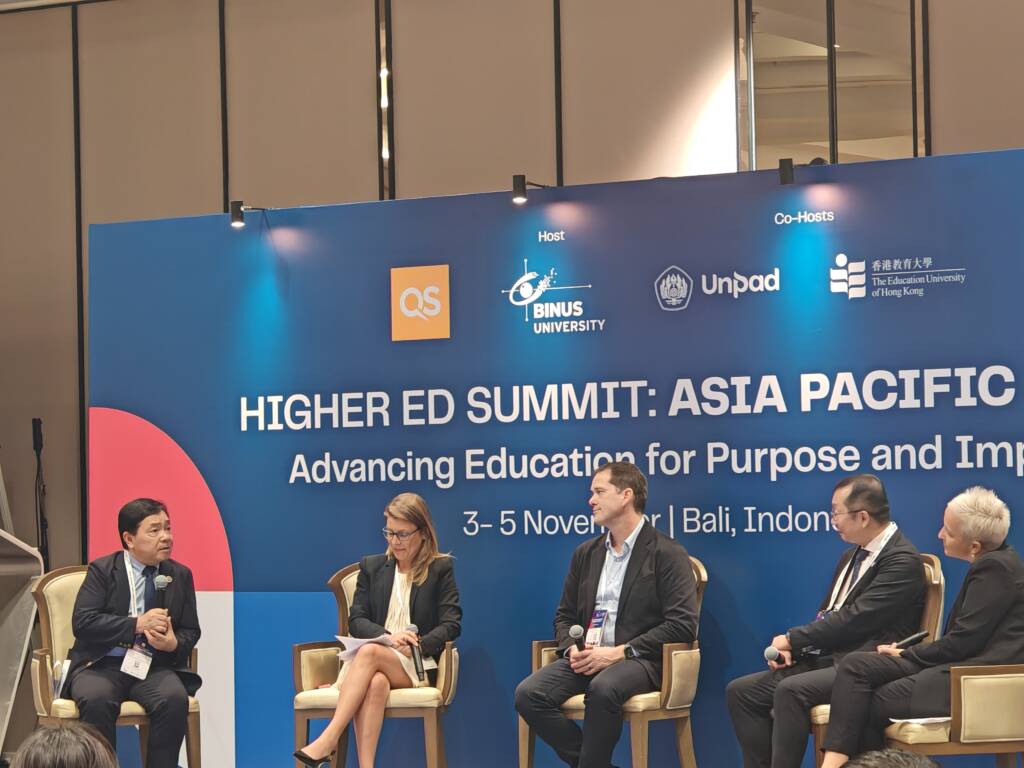
President Joshua Mok (left) speaks at the panel session, sharing HSUHK's perspectives on higher education development and regional engagement.
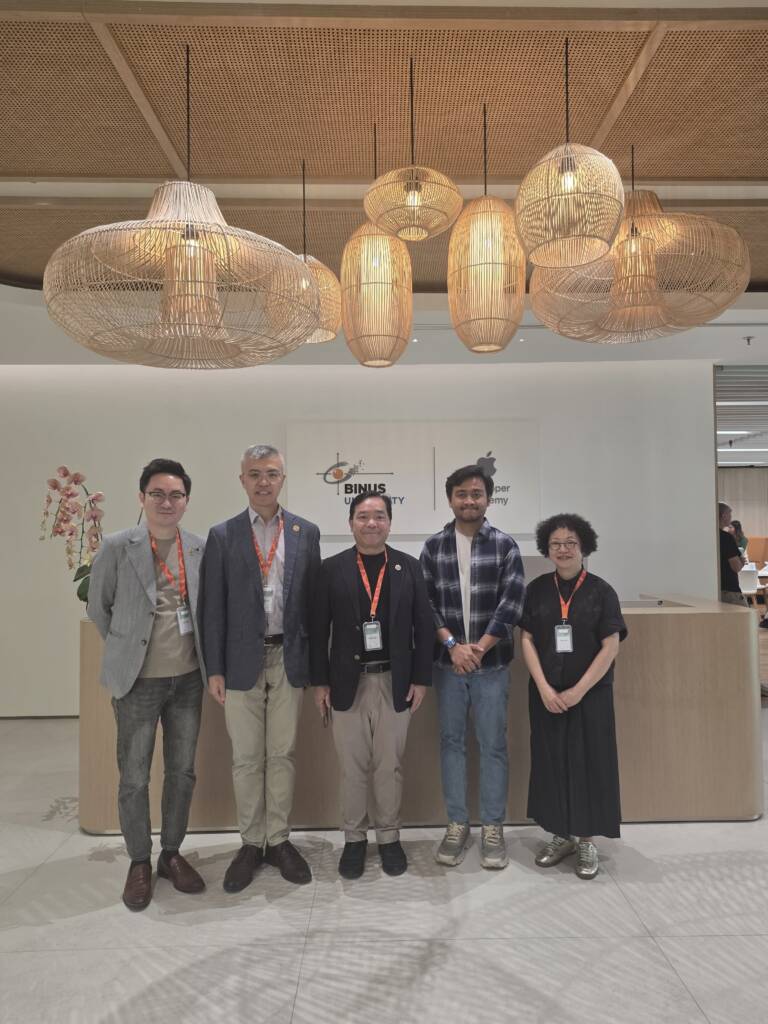
The HSUHK delegation visited Apple Developer Academy @ BINUS to learn its collaborative approach to nurturing digital talent and real-world app development.
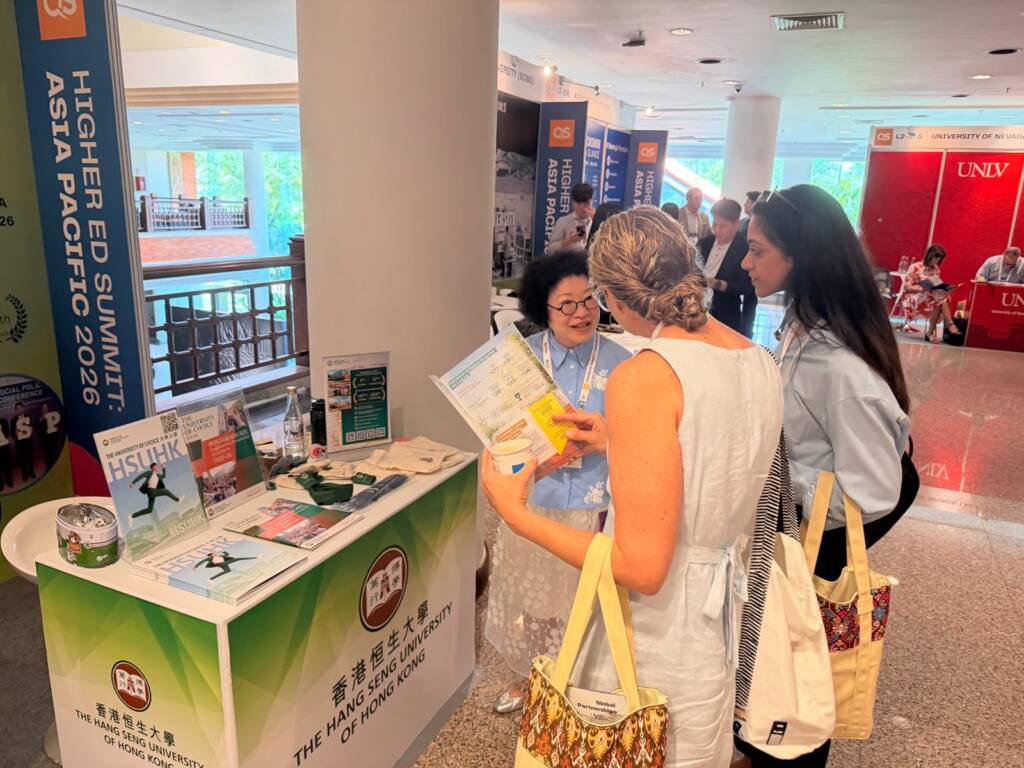
Participants show keen interest in HSUHK's programmes.